
Our Website Designing & Development training equips students with the knowledge and skills to create professional, responsive, and fully functional websites. This program covers front-end development using HTML5, CSS3, JavaScript, and Bootstrap, enabling participants to design visually appealing and interactive web pages. Students will also learn backend basics with PHP, MySQL, and CMS integration like WordPress, allowing them to manage databases and dynamic content effectively.
Key concepts include UI/UX design, responsive web design, website optimization, SEO basics, and cross-browser compatibility. Participants will work on hands-on projects, building websites for businesses, portfolios, or e-commerce platforms. By the end of the course, learners will understand the complete website development lifecycle, from planning and design to deployment and maintenance.
This training also focuses on practical exposure to modern frameworks and tools, preparing participants for real-world web development projects. Whether your goal is to become a frontend developer, full-stack developer, or web designer, this course provides a strong foundation for a career in website development.
Our Python Development training program is designed for beginners and professionals looking to master Python programming for software development, data analysis, automation, and web applications. Students will learn Python syntax, data structures, loops, functions, and object-oriented programming (OOP).
The course also covers Python libraries such as NumPy, Pandas, Matplotlib, and Django/Flask, enabling participants to handle data efficiently, create visualizations, and develop web applications. Practical sessions include scripting, automation tasks, and small real-time projects to provide hands-on experience.
Key concepts taught include error handling, file operations, modules and packages, API integration, and database connectivity. Participants will gain skills to develop desktop apps, web applications, and automation scripts, making them highly employable in IT, data analysis, and AI-related fields.
By the end of this program, learners will be proficient in Python and ready to apply their skills in real-world projects, such as automation tools, data-driven applications, and backend development.

The MERN Stack Development training is tailored for students aiming to become full-stack developers. This program focuses on the MongoDB, Express.js, React.js, and Node.js (MERN) stack, providing complete exposure to modern web development.
Students will learn frontend development with React, including components, state management, and hooks, along with backend development using Node.js and Express, including API creation, authentication, and routing. MongoDB is taught for database management, CRUD operations, and schema design, ensuring participants can create full-stack applications from scratch.
Practical projects include building e-commerce platforms, social media apps, and dashboards, giving learners hands-on experience with deployment and debugging. Key concepts like RESTful API integration, responsive design, server-side scripting, and deployment on cloud platforms are also covered.
Upon completion, students will be equipped to develop, deploy, and maintain full-stack web applications, making them highly valuable for startups, IT companies, and freelancing opportunities.
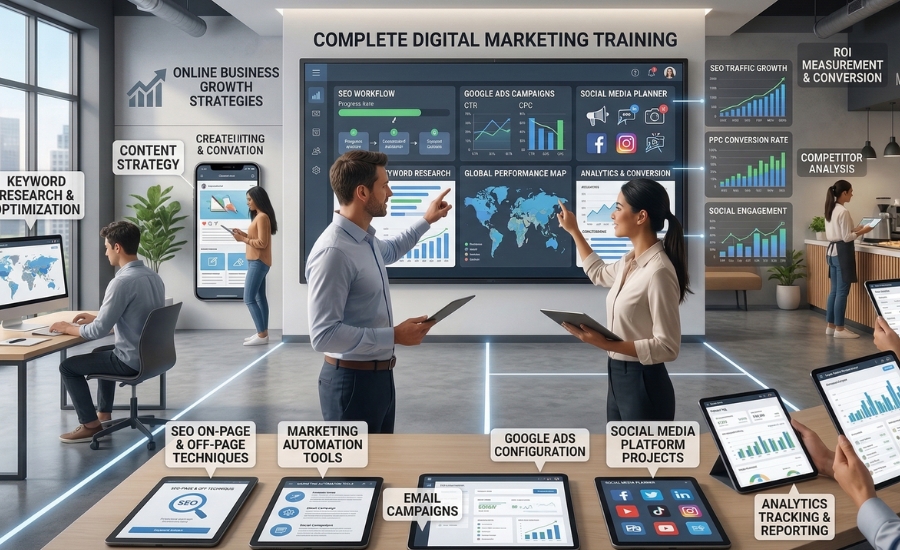
The Digital Marketing training teaches students to drive online business growth using modern marketing strategies. Topics include SEO, SEM, Google Ads, social media marketing, content strategy, and email campaigns.
Students learn keyword research, on-page & off-page optimization, analytics tracking, competitor analysis, and marketing automation. Practical projects involve creating campaigns for social media platforms, optimizing websites, and using Google Analytics.
Key concepts include customer engagement, ROI measurement, lead generation, and conversion optimization. Graduates gain skills to manage digital campaigns for startups, e-commerce, and established businesses, enhancing employability.
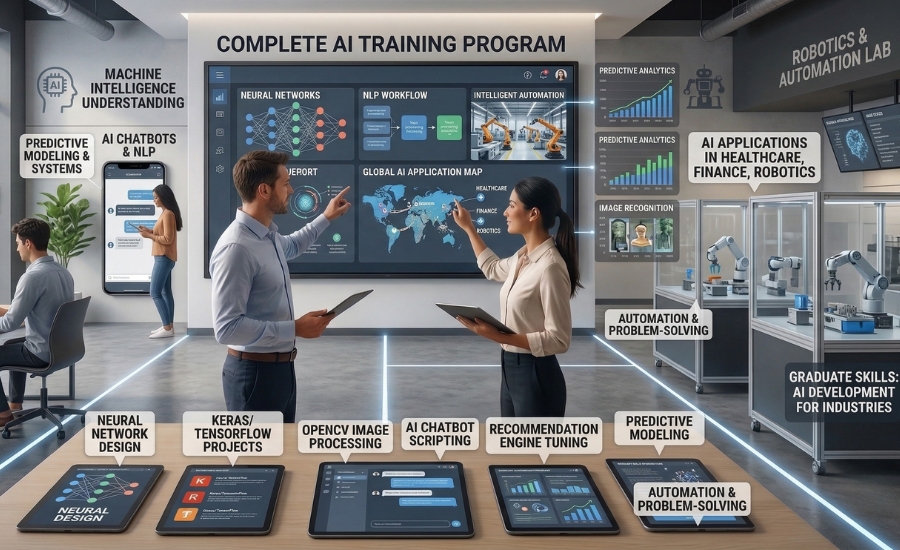
The AI training provides an understanding of machine intelligence and smart systems. Students learn AI algorithms, neural networks, natural language processing, and intelligent automation.
Key languages and tools include Python, TensorFlow, Keras, and OpenCV. Projects focus on image recognition, AI chatbots, predictive modeling, and recommendation systems.
Concepts cover AI applications in real-world scenarios, problem-solving, and automation, enabling learners to contribute to AI development in industries like healthcare, finance, and robotics.

The Data Science training equips students with data collection, analysis, and visualization skills. Key languages include Python and R, with libraries like NumPy, Pandas, Matplotlib, Seaborn, and Scikit-learn.
Students learn data preprocessing, statistical analysis, exploratory data analysis, predictive modeling, and visualization techniques. Practical projects include real-world datasets, business insights, and dashboards.
Concepts emphasize decision-making, trend analysis, machine learning basics, and business intelligence, preparing learners for roles like Data Analyst, Business Analyst, and Data Scientist.
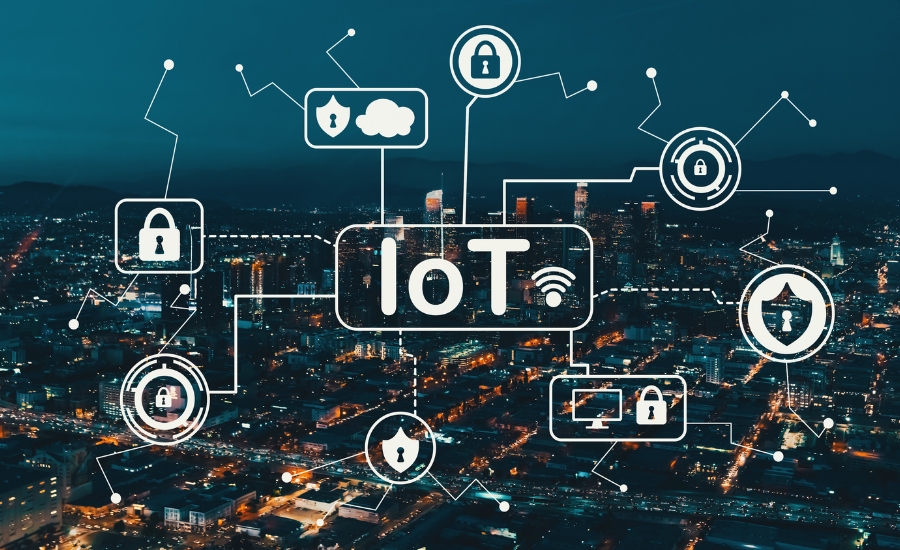
The IoT training teaches students to connect devices and build smart systems. Topics include sensors, microcontrollers, Raspberry Pi/Arduino, IoT protocols, and cloud data storage.
Practical projects involve home automation, smart agriculture, industrial monitoring, and wearable devices. Concepts focus on real-time monitoring, remote control, automation, and IoT security.
Learners gain skills for careers in smart devices, embedded systems, and industrial IoT solutions.

The Embedded Systems training teaches hardware-software integration using microcontrollers. Topics include Arduino, Raspberry Pi, embedded C programming, sensors/actuators, and real-time control systems.
Practical projects involve robotics, automation, and device control systems. Concepts focus on system design, debugging, interfacing hardware with software, and developing intelligent devices.
Learners can pursue careers in electronics, robotics, and industrial automation.

The MATLAB training provides students with engineering and scientific computing skills. Topics include matrix operations, signal processing, image processing, simulation, and data visualization.
Projects include engineering simulations, real-time data analysis, and algorithm development. Concepts emphasize problem-solving, numerical analysis, and model-based design.
MATLAB knowledge prepares students for engineering, research, and data analysis roles.

The Automation training focuses on industrial and software automation. Topics include PLC programming, robotics, Python scripting, workflow optimization, and process automation.
Projects involve automating repetitive tasks, manufacturing simulations, and real-time process control. Concepts focus on efficiency, error reduction, and automation system design, preparing learners for careers in industrial automation and software development.

The Networking training teaches computer networks, protocols, and administration. Topics include LAN/WAN, TCP/IP, routing, switching, firewall configuration, and network security.
Practical projects involve network setup, troubleshooting, VPN configuration, and monitoring systems. Concepts focus on network design, administration, security, and optimization, preparing learners for roles in network engineering, cybersecurity, and IT administration.
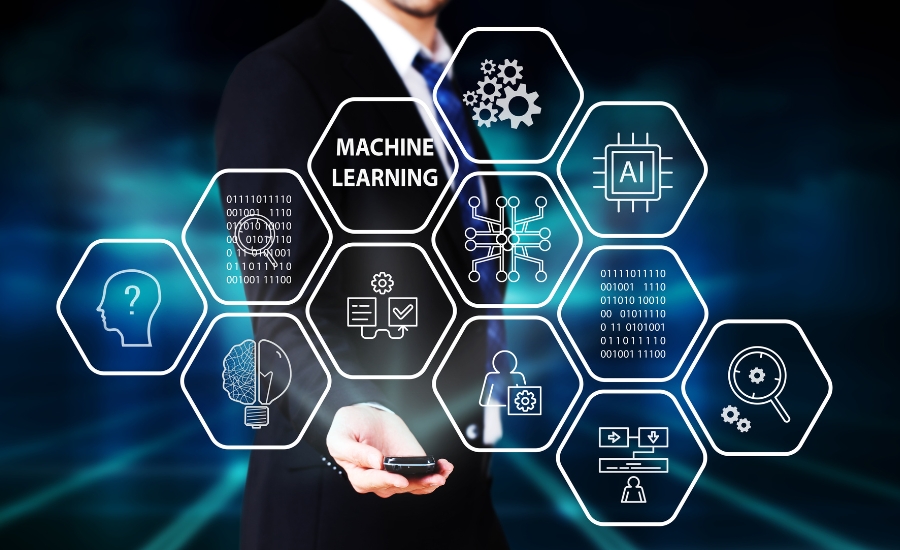
Our Machine Learning (ML) Industrial Training program is designed to provide students and professionals with a comprehensive understanding of ML algorithms, concepts, and practical applications, preparing them for careers in data science, artificial intelligence, predictive analytics, and related fields. Using Python as the primary programming language along with essential libraries such as Scikit-learn, Pandas, NumPy, Matplotlib, and Seaborn, participants will learn how to collect, clean, analyze, and visualize data effectively. The course covers a wide range of topics including supervised learning algorithms like Linear Regression, Logistic Regression, Decision Trees, Random Forests, and Support Vector Machines, as well as unsupervised learning techniques like K-Means Clustering, Hierarchical Clustering, and Association Rules. Learners will also explore data preprocessing, feature engineering, dimensionality reduction, model evaluation metrics such as accuracy, precision, recall, F1-score, and ROC-AUC, and gain an introduction to neural networks and deep learning basics. The program emphasizes hands-on experience with real-world datasets, allowing participants to build projects like predictive analytics for sales and stock trends, customer segmentation, recommendation systems for e-commerce platforms, fraud detection systems, and anomaly detection models, giving them practical exposure to real industry challenges. By the end of the course, students will be capable of developing, training, evaluating, and deploying ML models independently, gaining both theoretical knowledge and practical skills to contribute to AI, ML, and data-driven projects across diverse industries. This training is ideal for students, IT professionals, and enthusiasts seeking roles such as Machine Learning Engineer, Data Scientist, or AI Developer, ensuring they acquire the tools, confidence, and experience to succeed in the rapidly evolving field of machine learning and artificial intelligence.
Our CRM Software Development training teaches students and professionals how to design, code, and deploy a custom CRM system from scratch using modern programming technologies. Unlike ready-made platforms, this training focuses on building CRM solutions by coding, giving participants complete control over functionality, customization, and integration.
Participants learn to develop core CRM modules such as Lead Management, Customer Database, Sales Pipeline Tracking, Task & Activity Management, Reporting & Analytics, and Customer Support Ticketing. The course covers frontend development with HTML, CSS, JavaScript, React (optional), and backend development using Python, PHP, Node.js, or Java, along with database integration using MySQL, MongoDB, or PostgreSQL.
Key concepts include user authentication, role-based access control, CRUD operations, API integration, data security, and real-time notifications. Students also implement search, filtering, and reporting features to manage large customer datasets efficiently. Practical sessions include building fully functional CRM projects, simulating real-world business scenarios for sales, marketing, and support teams.
By the end of the training, learners can code and deploy a complete CRM system independently, apply custom features like email integration, analytics dashboards, and workflow automation, and understand how CRM software drives customer engagement, retention, and business growth. This program is ideal for software developers, IT professionals, and students looking to specialize in enterprise application development and business solutions.

The HR Management training covers modern human resource processes and software tools. Topics include recruitment, payroll, performance management, HR policies, and employee lifecycle management.
Students learn HR analytics, training & development planning, HR software usage (Zoho HR, SAP HR), and compliance management. Practical projects simulate real-world HR processes, from recruitment to performance tracking.
Key concepts focus on strategic HR management, workforce planning, employee engagement, and organizational development, preparing students for HR executive and manager roles.
BDS IT Solution delivers expert SEO, digital marketing, web, and app development services to boost growth, traffic, and engagement.
© 2020 Created with BDS IT SOLUTION
